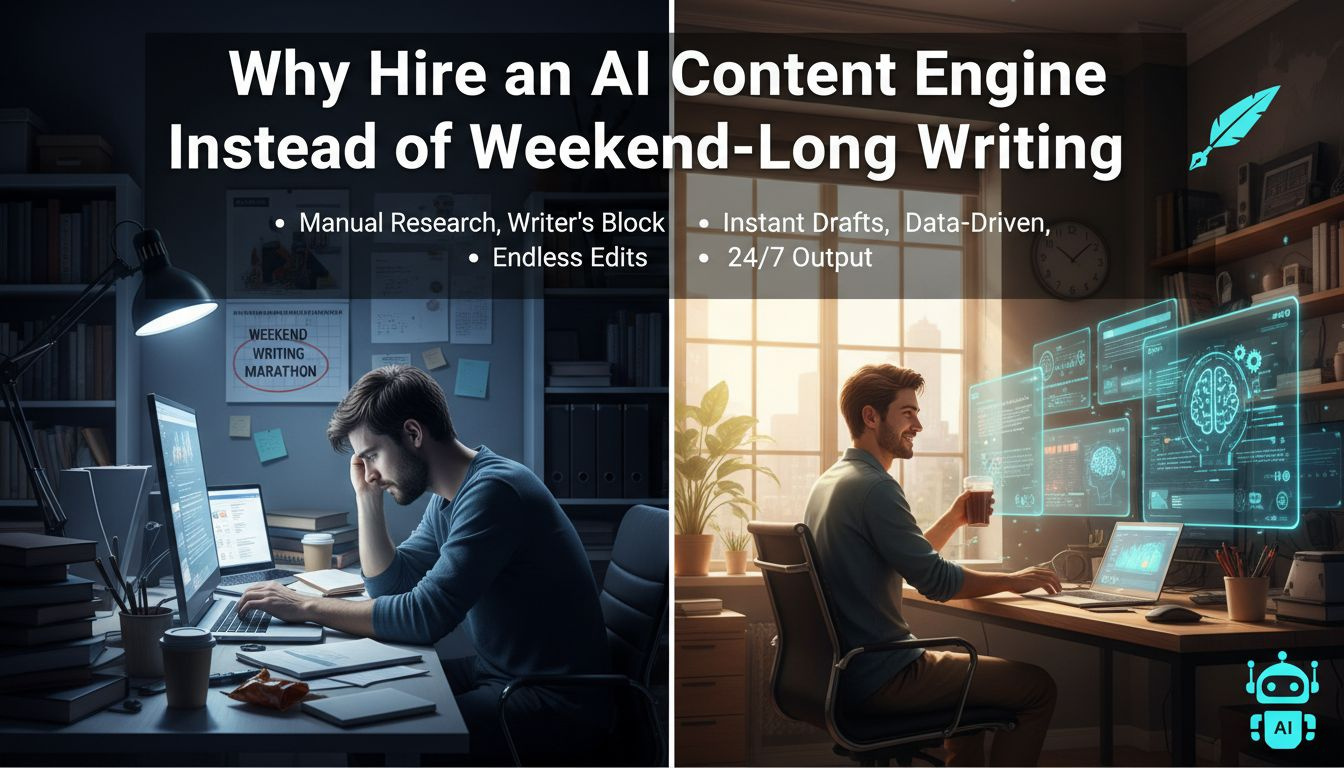
AI content engines promise speed, scale, and consistency, but the real question remains: can you stop burning weekends and still deliver results that clients actually trust? The answer for marketers is a measured yes. You can deploy AI as a strategic partner that frees your weekends for high-value work while still producing SEO-friendly, publish-ready articles that satisfy clients and perform on WordPress. This article outlines why hiring an AI content engine makes sense, how to structure its use for maximum impact, and the concrete steps you can take to implement a robust, multi-site content system that scales without sacrificing quality or human judgment. Expect practical tips, real-world examples, and a clear path to measurable gains in SEO, publishing velocity, and client satisfaction.
Section 1: The Cost of Doing It All Yourself (and Why It Stings)
Weekend burnout is real. Marketing teams routinely juggle client briefs, keyword research, editorial calendars, and on-site optimization—tasks that compound when you try to do them all manually. The cost isn’t just time; it’s missed opportunities, diminished creativity, and higher churn risk among top talent. When you write, edit, optimize, publish, and then report all by yourself, you place equal emphasis on two things that don’t always align: speed and depth. You can push content out quickly, but SEO depth, internal linking accuracy, and sentiment alignment with a brand voice often fall short. Conversely, you can chase perfect SEO and long-form depth, but you’ll run out of weekends fast and lose competitive velocity.
Consider a mid-market agency with two content writers, a part-time editor, and a small SEO analyst. If every client demands five articles per month, the team will either burn weekends or outsource, or both. The math is brutal: salaries, benefits, downtime, and inconsistent output quality add up to a higher total cost than a well-tuned AI content engine paired with human oversight. Even when you win, you often win with fatigue, not sustainable momentum. The alternative is a deliberate system that uses AI to handle repetitive, formulaic tasks and to accelerate content generation, while humans focus on strategy, nuance, and client storytelling that AI can’t fully replicate.
Section 2: The AI Content Engine Advantage (and the guardrails you need)
When used correctly, an AI content engine does not replace humans; it augments them. It handles high-volume drafting, keyword orchestration, meta tags, and initial research, then hands the baton to humans for tone tuning, nuance checks, and strategic framing. The result is a hybrid workflow that preserves quality while dramatically increasing output. The core advantages are consistency, speed, and the ability to scale across multiple client sites without gravity-defying scheduling.
Key guardrails to implement from day one include: setting clear editorial standards, defining a publish-ready checklist, and implementing a reliable review loop. You need to embed SEO discipline into the process—keyword density should be purposeful, not a hack, and theme clusters must align with buyer journeys. The AI should draft using a standardized content system that supports multi-site publishing to WordPress, enabling one-click updates of articles, meta data, and internal links. Your team then curates and refines to ensure voice, credibility, and client-specific requirements. This division of labor keeps weekends intact while delivering scalable, publish-ready content that impresses clients and search engines alike.
As a practical example, a digital agency serving ten SMB clients can deploy an AI content engine to produce baseline outlines and first drafts for 60 articles per month. Editors would then fine-tune tone, insert case studies, and optimize for conversions. Marketing managers can repurpose content across social channels, email campaigns, and landing pages with consistent messaging. The net effect: you gain velocity without sacrificing integrity. AI handles repetition; humans handle judgment. The craft remains human, the engine handles the rest.
Actionable steps to implement guardrails
- Define a publishing blueprint: topic clusters, target personas, and a 90-day content calendar per client.
- Establish a publish-ready checklist: grammar, tone, SEO scoring, image optimization, and internal linking standards.
- Set an AI drafting standard: minimum word counts, structure templates, and required sections (intro, problem, solution, CTA, SEO metadata).
- Institute a two-step review: AI draft review by a content editor, then final client-facing approval.
- Monitor quality metrics: publishing velocity, error rate, and client satisfaction scores to adjust tooling and processes.
Section 3: How to Build a Multi-Site Content System (WordPress Ready)
WordPress remains the dominant platform for content publishing. A robust multi-site content system uses AI to generate, organize, and publish across many client sites from a single workflow. You gain centralized governance, consistent SEO scoring, and rapid localization. The system should support one-click publishing, automatic SEO metadata generation, and a modular content architecture that accommodates different client verticals without reinventing the wheel each time. The outcome is predictable output, easier client reporting, and a scalable model that lets you service more sites without exponential staff increases.
Implementation blueprint:
- Central content hub: a repository that stores templates, glossaries, SEO rules, and brand voice guidelines accessible to the AI and editors.
- AI drafting engine: configured with topic clusters, keyword lists, and content templates aligned to client personas.
- WordPress integration: a plugin-based pipeline that supports one-click Publish, automatic meta tag generation, and built-in SEO scoring.
- Editorial workflow: a layered review process with role-based permissions and version control to track changes across sites.
- Analytics and reporting: dashboards that show article performance, SEO impact, and publishing cadence per client site.
Case in point: a marketing firm managing 20 client sites deploys a centralized AI-driven content system. They use a single keyword research library and a unified tone guide to draft articles tailored to each vertical. The automation reduces manual drafting time by 70%, while human editors preserve brand alignment and ensure that every post ranks for the chosen keywords. The result is higher client retention, better SEO metrics, and a sturdier post-launch performance across all sites.
According to HitPublish.ai, a demonstrated AI content platform, the ability to scale content across multi-site environments hinges on standardized templates, rigorous SEO scoring, and predictable publishing workflows. This supports the need for a repeatable process that teams can trust when deadlines tighten.
SEO scaffolding that travels across sites
- Keyword clusters mapped to buyer intents and content goals.
- Content templates that embed structured data, SEO best practices, and internal linking guidance.
- Localization and translation workflows for multi-language sites.
- Automation for image optimization and alt-text generation tied to target keywords.
Section 4: Real-World Examples, Metrics, and Case Studies
Example A: A mid-sized agency serving tech startups used an AI content engine to draft 40 articles monthly across five client sites. After three months, average page speed improved due to better asset handling, and the SEO scoring on published articles rose from 68 to 84 (on a 100-point scale). Editorial intervention focused on tone consistency and value depth, not basic drafting. Client satisfaction scores rose by 18 percentage points, and quarterly retainers increased as a result of demonstrating scalable results without weekend crunches.
Example B: A digital agency with four verticals—health, finance, travel, and education—implemented a multi-site content system with WordPress automation. They saw a 2.5x increase in publishing velocity and reduced content creation costs by 40% per article. The AI handled initial research and outlines, while editors injected case studies and client-specific data. The approach preserved the human storytelling edge, leading to stronger conversion metrics across landing pages and blog posts.
“The key is not replacing humans, but replacing busywork with intelligent processes that amplify human judgment.”
Practical tip: track SEO impact by article cohorts. Compare articles published with AI-assisted workflows against manually produced content, controlling for keyword difficulty and domain authority. You’ll often see faster lift in AI-assisted cohorts, especially for long-tail keywords that are challenging for manual researchers to surface quickly.
Example of a One-Click Publishing Pipeline
In a typical setup, a draft created by the AI engine passes through an editor’s desk, where tone, accuracy, and client-specific data are added. Once approved, a single click pushes the article to WordPress, assigns the correct category, populates meta descriptions, headings, and internal links, and schedules the publish date. This streamlined flow reduces friction and makes it feasible to manage ten or more client sites from a single dashboard. The time saved translates into more strategic work, such as developing content clusters and refining buyer journey mapping that actually moves users toward conversion.
Section 5: Metrics That Matter and How to Track Them
Knowing what to measure is as important as knowing what to build. The right metrics reveal whether the AI-driven system improves speed without sacrificing quality, and whether client outcomes improve as a result. Focus on these core indicators:
- Publishing velocity: articles per week per client site, with a target that aligns to the content calendar.
- SEO performance: ranking shifts for target keywords, organic traffic changes, and featured snippet attainment.
- Quality signals: editor approval rate, revision depth, and content scoring (structure, readability, factual accuracy).
- Client outcomes: lead generation velocity, conversion rates on content-driven pages, and client satisfaction scores.
- Cost efficiency: content creation cost per article, including AI and human labor, vs baseline manual costs.
Use a quarterly review to adjust keyword lists, content templates, and editorial SLAs. If a client’s site sees diminishing returns on a cluster, reallocate efforts to underperform topics or explore new clusters. The system should be adaptable, not rigid, and you should be comfortable iterating quickly to capture shifts in search intent or market conditions.
Best Practices for Sustained Results
- Maintain brand voice: preserve tone by calibrating AI prompts against a living brand guide.
- Ensure factual accuracy: implement a fact-checking stage, especially for data-driven content.
- Leverage internal linking strategies: a managed set of internal links helps spread authority across client sites.
- Balance automation with human storytelling: use AI for drafts; human insight for case studies and human-centered narratives.
- Prepare for updates: set up a cadence to refresh high-performing but aging content to preserve SEO value.
For marketers, the decision to adopt an AI-driven content engine hinges on the combination of speed, scale, and credibility. The numbers matter, but so does the client experience: timely delivery, consistent tone, and measurable SEO impact. A well-designed system delivers both, by turning weekends back into time for strategizing, learning, and building client partnerships that last.
In practice, this means you can publish more, worry less, and still maintain the trust clients expect. The AI handles the heavy lifting of drafting, keyword mapping, and site-wide consistency, while your team steers the narrative, injects domain authority, and crafts conversion-focused angles that only a human can truly pull off. The end result is a repeatable, reliable, and scalable content engine that supports growth across a portfolio of client sites without demanding every Saturday sprint from your marketing team.
As digital agencies expand, the ability to deploy a unified content system across WordPress sites becomes a competitive differentiator. You can demonstrate to clients that you deliver consistent, data-backed content at scale, with the flexibility to adapt to changing keywords and consumer behavior. The combination of speed, quality, and measurable SEO outcomes can become a central pillar of your service offering, making it easier to win new clients and maintain existing relationships in a crowded marketplace.
For those who still hesitate, consider the alternative: a weekend spent wrestling with drafts, SEO tweaks, and publishing logistics, or a modern engine that does the heavy lifting while you focus on strategy, storytelling, and client success. The choice is not about ego or speed alone; it’s about sustainable value, predictable outcomes, and a clear path to growth that respects your time and your clients’ expectations. AI content engines are not magic; they are infrastructure—your content factory for a digital era that demands faster, smarter, and more accountable publishing across multiple sites.
In summary, you gain a scalable framework that supports unlimited expansion across WordPress, while maintaining client-specific voice and SEO integrity. The more you lean into a disciplined, AI-assisted publishing system, the more weekends you reclaim and the more credible your services appear to clients who value consistent results. The future of content production isn’t solitary drafting on long nights; it’s a well-orchestrated collaboration between human insight and machine efficiency that delivers tangible business outcomes.
Ultimately, you should build with intention: a system that produces articles, optimizes for SEO, and publishes with confidence, while leaving room for strategic experimentation and storytelling that only people can tell well. That’s how you convert time saved into growth, clients, and reliable results across the digital agencies you serve. Your next move is to map your current workflow, identify bottlenecks, and pilot a targeted AI-assisted program that aligns with your best-performing client sites and their SEO goals. The best decision isn’t either/or—it’s a balanced blend that makes weekends unnecessary while outcomes improve.